What is N26 Interface in 5G and what’s its importance?
What is N26 Interface in 5G and what’s its importance?
What is N26 Interface in 5G and what’s its importance?
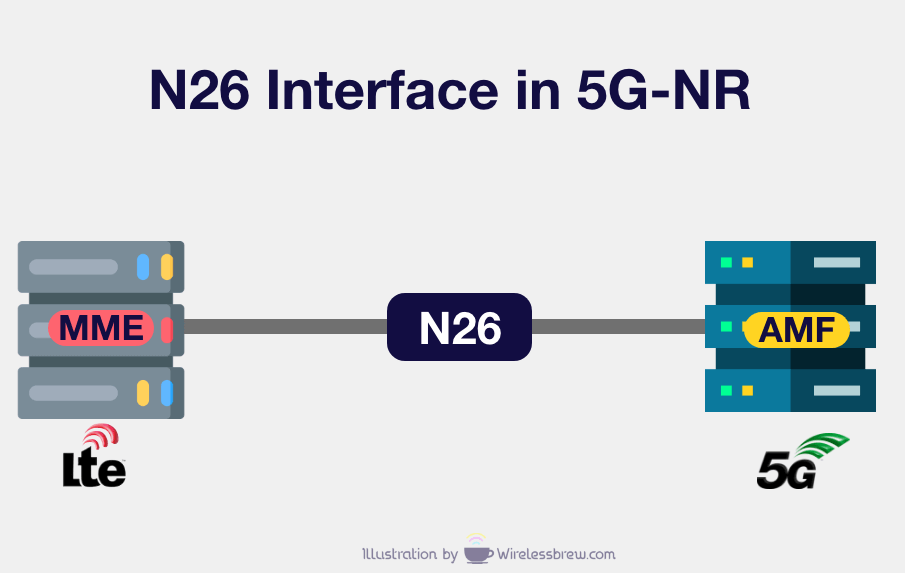
The N26 interface is an inter-Core Network interface between the MME (Mobility Management Entity) in EPC and the AMF (Access and Mobility Management Function) in 5GC. It enables interworking between the Evolved Packet Core (EPC) and the 5G Core (5GC).
Inter-RAT Mobility procedures involving mobility between LTE-EPC and 5G-NR-5GS utilize the N26 interface to exchange Mobility Management (MM) and Session Management (SM) states between the source and target RAT networks.
N26 interface support is critical to enable seamless continuity for voice services during inter-RAT handover between LTE and 5G. For example, if a Voice call is initiated in NR (i.e., VoNR), it can be continued when there is an Inter-RAT handover to LTE, transitioning to a VoLTE call.
Support for the N26 interface is optional for interworking, not mandatory. However, when N26 support is available, it significantly reduces latency during Inter-RAT procedures. N26 supports a subset of the functionalities (essential for interworking) that are supported over the S10 interface.
Networks that support interworking with EPC may support procedures that use the N26 interface or procedures that do not.
- With N26: Provides IP address continuity on inter-system mobility to UEs that support 5GC NAS and EPC NAS and operate in single registration mode.
- Without N26: Networks must support procedures to provide IP address continuity to UEs operating in both single-registration mode and dual-registration mode.
In such networks, the AMF provides an indication that "interworking without N26" is supported during initial Registration in 5GC. Similarly, the MME may optionally provide this indication during the Attach procedure in EPC (as defined in TS 23.401 [26]).
Another factor is the UE Subscription. The core network should not have any restrictions towards Core Network Type (5GC) or RAT restrictions for NR when the UE is camped on EPC. The HSS provides these restrictions to the MME, which then forwards them to the eNB. The MME and eNB use this information to decide whether mobility to 5GS (or NR connected to 5GS) should be permitted.
Mobility from LTE to NR with PDU Sessions and N26 Interface
When a UE has multiple PDUs in LTE Connected state and the network decides to perform Mobility to 5GS with N26 support, the system maps EPS Bearers to 5G PDU Sessions.
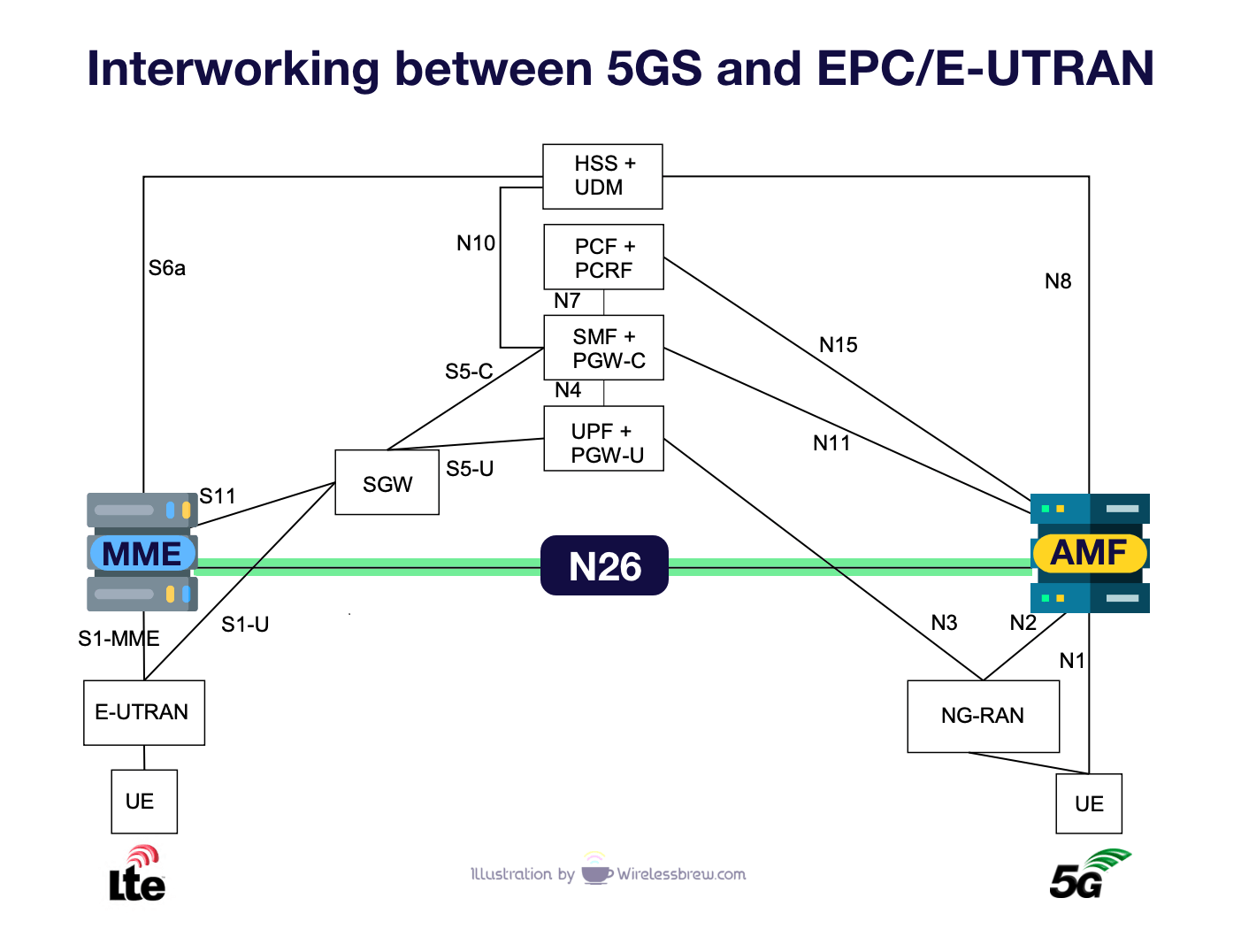
When link bearers are activated on LTE for each PDU session, the corresponding 5G PDU session ID is also mapped to each EPS Bearer. During mobility, the MME selects the PGW+SMF for PDN Connections that can be relocated to the target 5GS.
The PGW+SMF determines which PDN Connections can be relocated based on:
- Capabilities of the deployed 5GS.
- Subscription and operator policies.
- Whether seamless session continuity should be supported for the specific PDN Connection.
After successful mobility from LTE to NR, the 5GS indicates to the UE which corresponding EPS bearers have been successfully moved to 5GS.
If the network supports the N26 interface and the UE has indicated support for S1 and N1 modes, the network configures the UE to receive QoS rule(s) for the 5GS QoS flow(s). These correspond to the dedicated/default EPS bearer being activated. This is done via the Protocol Configuration Options (PCO) IE or the Extended Protocol Configuration Options (ePCO) IE in the ACTIVATE DEDICATED EPS BEARER CONTEXT REQUEST or ACTIVATE DEFAULT EPS BEARER CONTEXT REQUEST message. The UE stores these QoS rules for use during inter-system change from S1 mode to N1 mode.
If multiple PDU Sessions are moved from LTE and some cannot be transferred (e.g., no support on 5GS), the PGW+SMF and NG-RAN can reject those PDN Connections.
Example: If a UE has two active PDU Sessions (one for Internet, one for IMS) and performs mobility: If the MME selects a PGW for the Internet PDN that does not support session continuity, or if the AMF cannot retrieve the address of the corresponding SMF, the AMF does not move that PDN connection to 5GS. After mobility, the UE must trigger a new PDU session for the Internet PDN in 5GS.
Network Indication for N26 Support
In LTE RAT (MME)
If the UE indicates support for N1 mode in the ATTACH REQUEST message and the MME supports inter-system interworking with 5GS, the MME sets the IWK N26 bit in the EPS network feature support IE of the ATTACH ACCEPT message.
EPS network feature support information element: Interworking without N26 interface indicator (IWK N26) (octet 4, bit 7)
| Bit 7 | Description |
|---|---|
| 0 | Interworking without N26 not supported |
| 1 | Interworking without N26 supported |
In 5G RAT (AMF)
If the UE includes the S1 mode supported indication in the REGISTRATION REQUEST message, the AMF sets the IWK N26 bit in the 5GS network feature support IE of the REGISTRATION ACCEPT message.
- "Interworking without N26 interface not supported": If the AMF supports the N26 interface.
- "Interworking without N26 interface supported": If the AMF does not support the N26 interface.
5GS network feature support information element: Interworking without N26 interface indicator (IWK N26) (octet 3, bit 7)
| Bit 7 | Description |
|---|---|
| 0 | Interworking without N26 interface not supported |
| 1 | Interworking without N26 interface supported |
UE Operation based on IWK N26 Indication
The UE operates as follows when supporting S1 mode:
- If IWK N26 = "not supported" (Bit 0): UE should operate in Single Registration Mode.
- If IWK N26 = "supported" (Bit 1):
- If UE supports Dual Registration Mode: It may operate in dual-registration mode.
- If UE only supports Single Registration Mode: It should operate in single-registration mode.
Registration Modes
The UE can operate in either Single Registration mode or Dual Registration mode. This feature is not controlled by the network and is independent of UE implementation (though influenced by the network's N26 support).
Note: Support for Single Registration mode is mandatory for UEs that support both 5GC NAS and EPC NAS.
Single Registration Mode
In Single Registration mode, the UE has only one active MM state (either RM state in 5GC or EMM state in EPC) at any given time. It is either in 5GC NAS mode or EPC NAS mode.
- Operation: The UE maintains a single coordinated registration for 5GC and EPC.
- Mobility EPS -> 5GC: UE maps EPS-GUTI to 5G-GUTI.
- Mobility 5GC -> EPS: UE maps 5G-GUTI to EPS-GUTI.
- Context: When moving from 5GC to EPC, the UE keeps the native 5G-GUTI and security context to reuse when returning to 5GC.
- Constraint: The UE cannot be registered to both 5GC and EPC simultaneously.
Dual Registration Mode
In Dual Registration mode, the UE handles independent registrations for 5GC and EPC using separate RRC connections.
- Operation: UE maintains 5G-GUTI for 5GC and EPS-GUTI for EPS independently.
- Identity:
- Provides native 5G-GUTI for 5GC registrations.
- Provides native EPS-GUTI for EPC Attach/TAU.
- Flexibility: The UE may be registered to 5GC only, EPC only, or both 5GC and EPC simultaneously.
Procedures Supported with N26
When the MME supports the N26 interface, it enables the following interworking procedures:
- Attach procedure
- EPS to 5GS Mobility Registration procedure
- 5GS to EPS Idle mode mobility procedure
- 5GS to EPS Handover
- EPS to 5GS Handover
- 5GS to EPS Handover Cancel
- EPS to 5GS Handover Cancel
Further Reading (3GPP Specifications)
For detailed information, refer to the following 3GPP specifications:
- 3GPP TS 23.401: GPRS enhancements for E-UTRAN access
- 3GPP TS 23.501: System architecture for the 5G System (5GS)
- 3GPP TS 23.502: Procedures for the 5G System (5GS)
- 3GPP TS 33.501: Security architecture and procedures for 5G System
- 3GPP TS 24.301: Non-Access-Stratum (NAS) protocol for EPS
- 3GPP TS 36.413: S1 Application Protocol (S1AP)
- 3GPP TS 29.272: MME and SGSN related interfaces based on Diameter protocol
- 3GPP TS 29.274: Tunnelling Protocol for Control plane (GTPv2-C)
- 3GPP TS 23.003: Numbering, addressing and identification

WirelessBrew Team
Technical expert at WirelessBrew, specializing in 5G NR, LTE, and wireless system optimization. Committed to providing accurate, 3GPP-compliant engineering tools.
Up Next
More 5g nr Articles →